The Legacy of Baudelaire's Dandy
Note: I recently wrote this essay for a university class on the history of beauty. It had been a while since I had written a formal conventional essay. The prompt was "Compare and contrast at least two artworks, examining the ways that they engage with the aesthetics of the dandy. Refer to Baudelaire's theories of dandyism." I chose the topic because I like his prose poems and love the two artworks I shall speak of. Here it is:
1. Introduction
Most associate the dandy with wry, wealthy and fashionable men of 19th century Europe, however, dandyism should be considered as a broader aesthetic ideology which has crossed cultures throughout history and continues to be relevant today. One of dandyism's most influential theorists was the French poet Charles Baudelaire, whose 1863 essay The Painter of Modern Life described dandyism as more than a fashion style, but a way of life with its own belief system. This essay will examine how Baudelaire’s writing still remains relevant for understanding how individuals distinguish themselves through affected fashion and behaviour, and shall discuss how dandyism manifests in two contemporary artworks: Pipilotti Rist’s Ever is Over All (1997) and André Cadere’s Barres de boi Rond (1970-78).
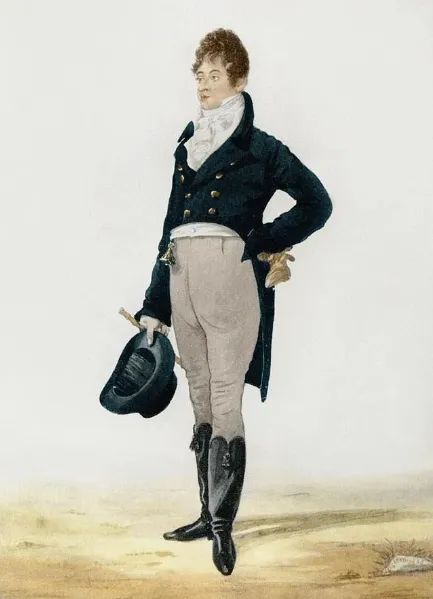
Figure 1: Robert Dighton. Caricature of the Regency dandy, George Bryan "Beau" Brummell (1778-1840). 1805, watercolour.
2. Context
Baudelaire venerated the dandy as a heroic modern figure, describing him as a man of cultivated superiority who enjoys causing others to marvel at his unique, elegant style. For the dandy, elegance is “simplicity exaggerated” (Eco 2004), which can be observed in portraits of the famous dandy George “Beau” Brummell [Figure 1]. Dandyism is described as a “cult of the self” in which one lives for the pursuit of self-beauty with the goal of “astonishing others [while] never being astonished” (Baudelaire 1867, 27-28). Unlike his oft-conflated twin brother, the flaneur, the dandy does not seek to blend into the crowd in order to observe, but seeks to stand out in order to be seen (1867; Kerr 2015). Although Baudelaire was transgressive in his poetry, he was a staunch defender of the French aristocracy and his essays show a vitriolic contempt for women, describing them in binary opposition to dandies. While his views may be a product of his time and place, this kind of male chauvinism is still associated with dandyism today, with top hats and fedoras being signifiers on the internet for naive misogyny [Figure 2]. It is this aspect of dandyism that contemporary artists continue to find interesting.

Figure 2: @Sssnakepit. Just saw a girl go for the jock again.... 2024, internet meme.
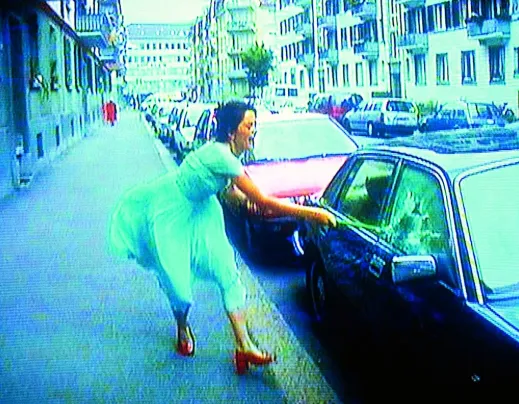
Figure 3: Pipilotti Rist. Ever Is Over All. 1997, video .
Although Rist and Cadere can be said to engage with dandyist aesthetics, it is by no means the primary way to read their artworks. Rist’s video Ever is Over All [Figure 3] is inseparable from the context of 1990s third wave feminism, sharing similarities with the art of the Riot Grrrl subculture, whose artists and musicians reappropriated the visual motifs of submissive femininity, making them damaged and violent. The woman in Rist’s video walks down the street in a bright blue dress, carrying a flower which she then proceeds to use as a sledgehammer, breaking the windows of cars. Packed with symbols, one understands the cars and flowers to be diametrically opposed; one symbolizing man/modernity, the other woman/nature. Rist’s pinecone-like flower is also a reference to the maenids, female followers of Dionysus who would be sent into ecstatic and violent trances (Sevilla-Sadeh 2017). While the video risks being semiotically simple to the point of obviousness, its message a visual equivalent of the phrase “smash the patriarchy”, it is mediated through dreamlike and hallucinatory editing. The discussion of its meaning also becomes more interesting when compared with the 19th century views of women as outlined by Baudelaire.
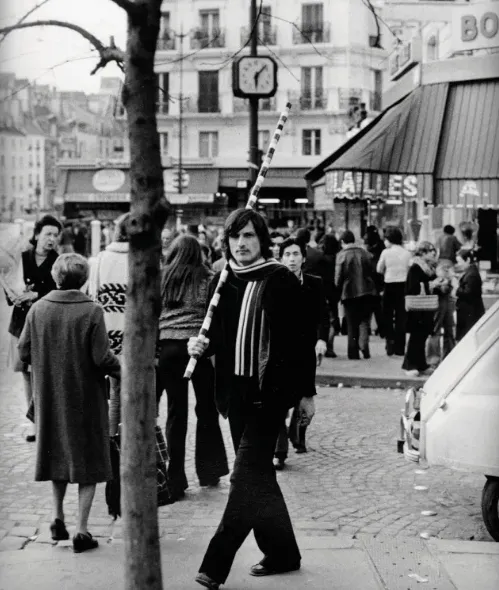
Figure 4: André Cadere presenting his work. 1973. Photographed by Bernard Borgeaud.
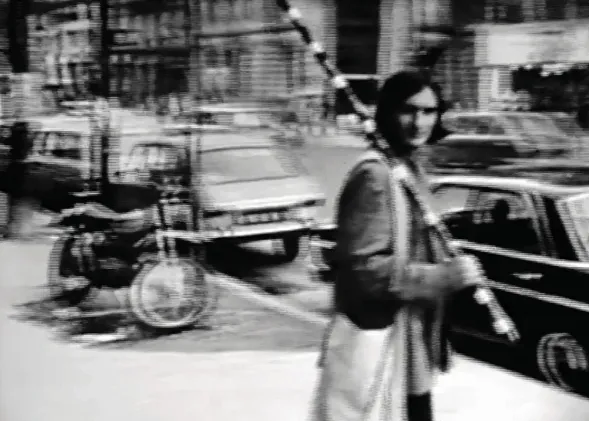
André Cadere’s work, on the other hand, engages with dandyism not to critique patriarchal ideology, but to critique art institutions as capitalist entities. Cadere was a Romanian artist who in 1967, migrated from Communist Poland to Paris where conceptual art and minimalist abstraction were gaining popularity. Cadere soon abandoned his Op Art paintings when he realised that prestigious galleries served to turn avant-garde artworks into decorations and investments for the rich (Woodruff 2020). From 1970 until his death in 1978, he produced over 180 “barres de bois rond” - colourful sticks that he carried everywhere around the city and into other’s art exhibitions, displaying them alongside the other artworks. By “exhibiting” his own work in non-gallery spaces [Figure 4], as well as inside them without invitation, he emphasized the independence of his own work (Jolly 2013). In this way his barres were a kind of one-up-manship, showing how he, an outsider, was freer than his successful peers. Like much minimalist art at the time, his barres were semiotically unclear on purpose. "I am not a teacher and there is nothing to discuss, nor to write. The purpose of my work is to be seen.” (Jolly 2013, 121).
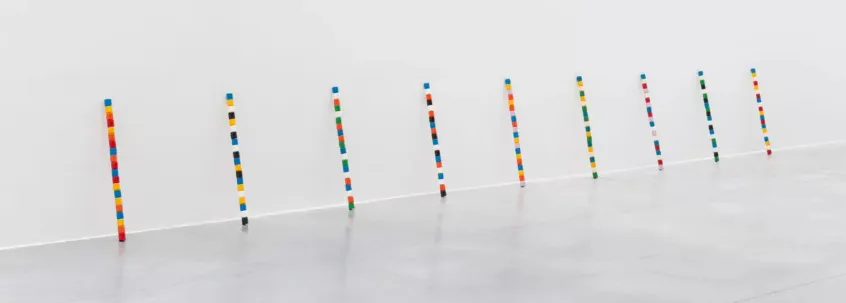
Figure 5: André Cadere. Barres de bois rond. 1970-1978, painted wood.
3. Artificial beauty
Beauty, for Baudelaire, was not to be found in nature but in opposition to it, through art and the artificial (1867). Beauty was achieved not only in the masking of “natural ugliness” through cosmetics and body-shaping costumes, but also had to contain “a hint of the bizarre” (Eco 2004, 331). It is this artificial and bizarre beauty that can be found in Rist and Cadere’s artworks. While the photo of Cadere [Figure 4] already shows a stylish figure with movie-star looks, it is the strangeness of the barre which makes him stand out. The stick does not appear to have any clear function: it is far too long for a cane and on closer analysis, is far too fragile to have any material use, yet, removed from its context, it is also unlikely that anyone in the street would view it as art. Rather, the barre’s only function was to call attention to the beauty of “presence itself” (Woodruff 2020, 182). One could say the same of Rist’s strolling woman, who carries a similarly colourful flower-staff; yet it is the video itself which commands attention in its bizarre artificiality. One immediately notices intensely over-saturated colour scheme, the retina-burning reds and cyans, the candy-like Red Hot Poker flowers which even in nature look artificially vivid. Cadere’s barres are painted to be highly-visible like Rist’s colours [Figure 5], yet his clothes are largely simple and monochromatic. Rist’s woman, however, wears flamboyant colours more common in modern iterations of dandyism, such as the hi-vis zoot suits worn by Congolese Sapeurs. It seems all spectacular fashion contains elements of the loud, artificial and bizarre, being the best way to differentiate oneself from one’s surroundings.

Figure 6: Natalya Kadyrova. The Congo Dandies. 1975, photograph.
4. Being seen
The dandy distinguishes himself as superior to the masses, yet also requires their attention to define his own identity. “Without the presence of a spectator [...] the dandy becomes simply another mannequin on which to hang finely tailored clothes” (Kerr 2015, 114). Attention is the measure of success, and Cadere’s interviews are filled with statements like “the purpose of my work is to be seen,” and “my only goal is to show and to keep that word from becoming useless” (1978, as cited in Jolly 2013, 120). While these statements suggest Cadere wants his barres to be the centre of attention, not himself, it is clear that he and his work are inseparable; their proximity to Cadere is what makes them noteworthy, whether they are in the midst of being carried, or were left somewhere by him as a public intervention. Cadere was usually met with “suspicious stares or sidelong glances” (Jolly 2013, 137) which were appropriate to the ambiguous nature of his work; the glances received by the woman in Rist’s video, however, are humorously incongruous. She is politely ignored by pedestrians as she breaks car windows, and is even given a friendly salute by a passing policewoman. While Cadere’s flaneurie happens in the real world, Rist’s video seems to take place in a fever dream. This points to the gendered reality of flaneurie, in which it is less common for women to take leisurely strolls by themselves due to reasonable fears of unwanted attention. Cadere reports to be indifferent to the “kinds” of looks he receives, and betrays nothing with his expressions (Jolly 2013); Rist’s woman, however, does not express this blasé attitude. Rather, in this dreamworld, she is elated, laughing and rejoicing at being free from the indications of the (male) onlooker’s gaze.
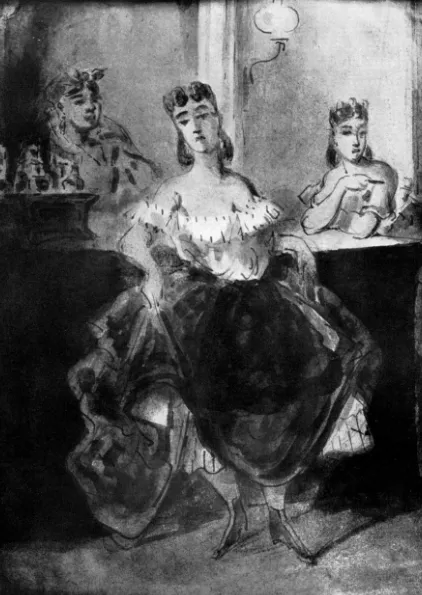
Figure 7: Constantin Guys. Three Women by a Bar. 1830, pen and watercolour.
5. Dandyism and chauvinism
“Woman,” according to Baudelaire, “is natural, that is to say, abominable. Also, she is always vulgar, that is, the opposite of a dandy” (1925, 228). The women he is referring to, more specifically, are those depicted in the sketches of Constantin Guys; always either respectable ladies in the arms of gents, or “lowly” courtesians waiting for men in bars [Figure 7]. The women in Guys’ sketches share many similarities with his dandies: expressions of affected boredom, heavy makeup, body-shaping attire, and an apparent desire to be looked at; yet Baudelaire does not afford these women with the same heroic subjectivity as he does for men. For him, women dress up not for their own sake but out of “a kind of duty [...] to astonish and charm us; as an idol, she is obliged to adorn herself in order to be adored.” (Baudelaire 1867, 33). While these comments may have been commonplace in the 1860s, the double standard around fashion as empowerment versus submission exists to this day. When Andre Cadere used his barres to turn himself into a walking spectacle, it may have been seen as attention seeking, but not as a form of courtship display; yet women who do the same are accused of seeking male attention. Rist’s video explores the way women are perceived in public, playing at once the “innocent” girl in her childlike dress, and the “hysterical” woman (Rist 2007). Baudelaire would condemn the “vulgarity” of the woman’s laughter and “irrationality” of her actions, but the video is designed to provoke these masculine belief systems by making their assumptions ridiculous. The gender politics in Cadere’s work are not explicit or intentional, but can be seen implicitly in his freedom to walk and attract attention without expectation of gender based judgement or harassment. No matter how intentional or subversive, Cadere and Rist’s artworks both reveal the gender biases implicit in dandyism.
6. Conclusion
This essay has examined how Baudelaire’s principles of dandyism have continued to inform the way men and women look, dress and act in public today, as evidenced by the artworks of Pipilotti Rist and Andre Cadere. Both artists have engaged with dandyist aesthetics of artificial beauty, and their work expresses the dandy’s desire to be seen, to astonish and to define oneself in relation to others. Finally, the artworks reveal how the male chauvinism of Baudelaire’s time continues to persist, defining who can be a dandy, and who is just seeking attention.
Bibliography
Baudelaire, Charles. 1967. The Painter of Modern Life and Other Essays. Garland Pub.
Baudelaire, Charles. 1925. Baudelaire, His Prose and Poetry. The Modern Library.
Eco, Umberto. 2004. On Beauty. MacLehrose Press.
Grundmann, Melanie. 2021. “On Dandyism.” Engelsberg Ideas. https://engelsbergideas.com/essays/decadence-and-dandyism/
Jolly, Matt. 2013. “The Barred Colors of André Cadere.” October 144 (Spring 2013): 115-148. https://www.jstor.org/stable/24586594?seq=1
Kerr, Darin. 2015. “The Beauty of Ideas in Their Persons - Dandyism and the Haunting of Contemporary Masculinity.” PhD diss., Bowling Green State University. OhioLINK. http://rave.ohiolink.edu/etdc/view?acc_num=bgsu1431098722
Rist, Pipilotti. 2007. “Pipilotti Rist In Conversation with Michele Robecchi.” In Documents of Contemporary Art: Moving Image, 1st ed., edited by Kholeif, Omar. Whitechapel Gallery and MIT Press.
Sevilla-Sadeh, Nava. 2017. “Street Maenedism: Features and Metaphors of Dionysian Ritural in the Work Ever is Over All by Pipilotti Rist.” Source New York 37 (1): 60-70. https://doi.org/10.1086/695757.
Woodruff, Lily. 2020. Disordering the Establishment: Participatory Art and Institutional Critique in France, 1958–1981. 1st ed. Duke University Press. https://doi.org/10.1215/9781478012085.